
Durable agents: the step that makes autonomy production-ready
Everyone talks about how intelligent AI agents are, but few ask what happens when the infrastructure fails mid-task. Discover why the difference between fragile and durable agents decides whether your automation is ready for production, or only for a demo.
4 min
October 1, 2026
There is a lot of talk these days about how intelligent an AI agent is, how many tasks it can handle, and how much autonomy an organization is willing to give it. One far simpler question rarely comes up: what happens when the infrastructure the agent runs on stumbles? The answer decides whether an agent is ready for production or only ready for a demo.
The risk nobody tests for
As long as an AI agent lives inside a chat window, an outage is a minor inconvenience. Someone refreshes the page and asks again. But agents are increasingly leaving the chat window. They process documents, send messages to other systems, wait for an API response, call an external service and then move on to the next step. At any of those moments, something can go wrong that has nothing to do with the agent's intelligence: a server restarts, a network drops for a few seconds, a cloud service becomes briefly unavailable.
In traditional applications, this is a well-known risk that teams have managed for years. With an autonomous agent, the risk grows for a simple reason: the agent decides for itself which action to take and in what order. When the process is interrupted, nobody knows exactly where the agent left off, least of all the agent itself. There is no human watching at that moment who can tell the difference between “this step is done” and “this step needs to be redone”.
Fragile versus durable agents
This brings us to a distinction we believe matters at least as much as how smart an agent is: is your agent fragile, or is it durable?
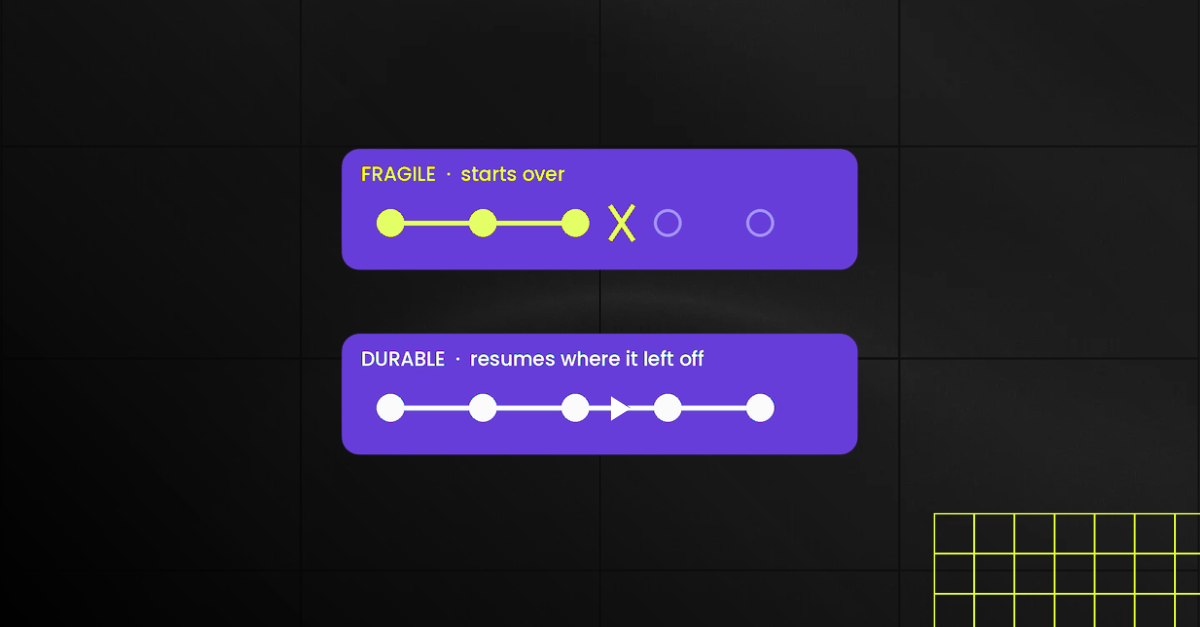
A fragile agent works perfectly as long as everything goes its way. The moment something falters, it loses track of where it was. It starts over from scratch, repeats an action that was already completed, or gets stuck unnoticed, waiting for a response that will never arrive.
A durable agent, by contrast, is built to survive interruptions. Every step it takes, every decision it makes and every action it performs is reliably recorded at the moment it happens. If the infrastructure fails mid-task, the agent resumes exactly where it left off once service is restored. Not from the beginning, not from a best guess, but from the last point that was confirmed as complete. Its context, its interim decisions and its progress are never lost.
The idea itself is not new. Workflow systems have applied this principle to ordinary business processes for years. What is new is applying it to agents that decide for themselves which action to take, rather than following a fixed, predictable sequence of steps. That makes it harder, because the system has to remember not only which step was executed, but also which decision the agent made along the way. This is exactly what makes “durable” a different and more demanding concept for agents than for conventional processes.
Why this matters more as agents become more autonomous
The more responsibility an organization hands to an agent, the more this distinction counts. A fragile agent that looks up information can simply start over after a failure without much harm done. But an agent that places orders, amends contracts, initiates payments or responds to an incident cannot simply repeat itself. The cost of a duplicated action, or of one that silently stalled, is no longer hypothetical.
Organizations experimenting with agentic automation today usually test whether the agent makes the right decisions. They rarely test whether it is fragile or durable. That is understandable: it is less visible, less exciting to demo, and it feels like an edge case. Until it stops being one, and a production process grinds to a halt at a moment when nobody is watching.
A familiar scenario
Imagine an organization deploys an agent to process incoming supplier invoices. The agent reads the invoice, checks the details against the purchase order, requests approval from a colleague when in doubt, and only books the invoice once that approval has come in. A perfectly ordinary process, until the server sending the approval request happens to be updating at that very moment.
After recovery, a fragile agent no longer knows whether the approval request was already sent. In the worst case, it sends it a second time or, worse, books the invoice without the approval ever having arrived. A durable agent picks up exactly where it left off: it knows the request has already gone out and simply keeps waiting for the answer. For the person on the other end, nothing seems to have happened. And that is precisely the point.
What this means for organizations starting with agentic automation
If you are automating processes with AI agents today, it pays to ask a few questions that have little to do with intelligence and everything to do with the difference between fragile and durable.
For each process an agent runs, do you know what happens if it is interrupted halfway? Is that agent fragile, or durable? Are there steps that would do damage if executed twice, such as a payment or an order? And would anyone notice if an agent quietly got stuck?
At MbarQ, drawing on our experience in process automation, we often see these questions asked only after a process is already live and an incident has occurred. They belong in the design phase, not in after-the-fact follow-up. Durability is not a layer you add to an agent later. It is a property that has to grow alongside the autonomy you give that agent, from day one.
In conclusion
Building an autonomous agent that makes smart decisions is a fascinating technical exercise. But the real value emerges when that same agent survives a bad day in production without a human having to step in. In the end, it is not an agent's intelligence that determines whether an organization can trust it with business-critical processes, but whether it is fragile, or durable.
The AI Translator: The Key to Successful AI Adoption
As Artificial Intelligence (AI) becomes increasingly important within organizations, the need to align technology and business more effectively is also growing. Many organizations want to implement AI but struggle to translate advanced technology into concrete and feasible business strategies. This is where the AI Translator comes in – a crucial link in successful AI adoption.
Read more
Interns at MbarQ: Learning, Innovating, and Growing Together
At MbarQ, we believe internships should be more than just a line on a resume, they should be a launchpad for real growth, learning, and meaningful contribution. Every year, we’re proud to welcome talented interns who bring fresh perspectives, curiosity, and energy to our team. In return, we strive to create an environment where they can explore, challenge themselves, and be part of something that matters.
Read more
This is the era of AI. In the past, AI was for scientists and technicians. Nowadays, it’s essential for everyone. Including your business.

Part of


© 2025 MbarQ all rights reserved