
From Apps to Agents: What Hendrik brought home from the European Power Platform Conference 2026
Is the era of business apps coming to an end? At EPPC 2026, one message stood out above all: AI agents are moving from assistants to coworkers. From Copilot-connected apps and autonomous agents to Agent 365 governance, Hendrik De Beck shares the key insights, practical takeaways, and why this shift matters for every Power Platform professional.
9 min
August 27, 2026
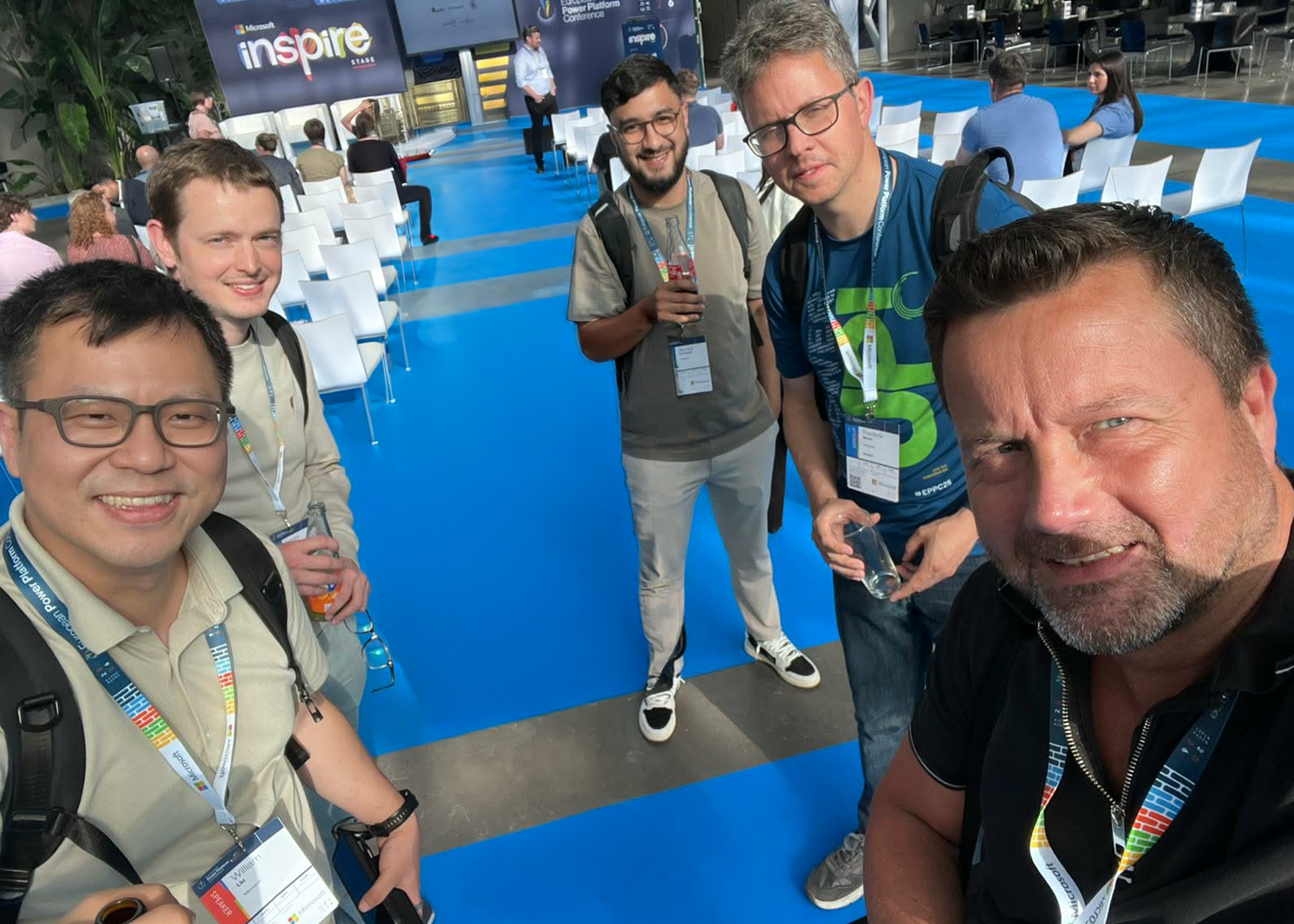
In late June, I traded the Belgian summer for four days at the Bella Center in Copenhagen and the European Power Platform Conference. EPPC is the leading European event dedicated entirely to Microsoft’s Power Platform, and this year the atmosphere felt different. It was less “here are the new buttons” and much more “here is how the entire way we build software is about to change.”
So instead of a session-by-session write-up, I want to tell it as one story, because that is how it landed for me. Almost everything at EPPC 2026 pointed at the same shift: we are moving from a world where we build and click through apps, to a world where AI agents do work alongside us, as long as we keep it safe. There are four stops on that journey, and then a word on what it all means for us: why everything is changing, how
Why everything is changing
The opening keynote did not sugarcoat it. Classic business apps are under real pressure, and Microsoft named three reasons. First, AI can now generate software faster than anyone can click screens together, so the barrier to building an app has effectively collapsed. Second, agents are swallowing the bread-and-butter app, enter some data now and look it up later, by simply doing the task across sales, service and finance. Third, once an agent does the work instead of a person, per-seat licensing starts to wobble.
"Any per-user business of ours will become a per-user and usage business"
Satya Nadella, quoted at the keynote
Microsoft’s answer is not to fight any of that. It is to pull it inside the platform: vibe-coding where you would normally hire a developer, proactive agents inside Dynamics, and Copilot Studio as the home for building agents. The reason Microsoft can absorb the shift rather than be disrupted by it comes down to what it already owns: roughly 3.7 million organisations on Microsoft 365, one identity system in Entra, data already sitting in SharePoint and Dataverse, and years of enterprise trust.
Apps aren't dying: the pendulum swings
Here is the nuance I did not expect: apps are not going away. Microsoft was clear that Power Platform will not collapse into one big chat box. In the session given by Scott Durow, he described it as a pendulum swing. Sometimes you want to be inside an app with full context, reviewing a projector working through a list of orders. Other times, you just need one thing out of an app while you are busy somewhere else, and the last thing you want is to navigate away and lose your train of thought.

The concrete step in that direction drew a lot of attention: model-driven apps can now be exposed as MCP servers. In plain terms, this gives your app a socket that Copilot can plug into. In Scott’s demo, he opened his Outlook calendar and typed “create timesheet records for every meeting this week”. This opened a model-driven app inside Copilot with the correct rules and security still applied, without ever opening the app itself. One thing to note for anyone costing this out: it needs Power Apps Premium licensing.
Building apps has also turned into a spectrum rather than a single method. The same map came back in several sessions: maximum guardrails on one end, maximum freedom on the other, and AI helping at every stop.
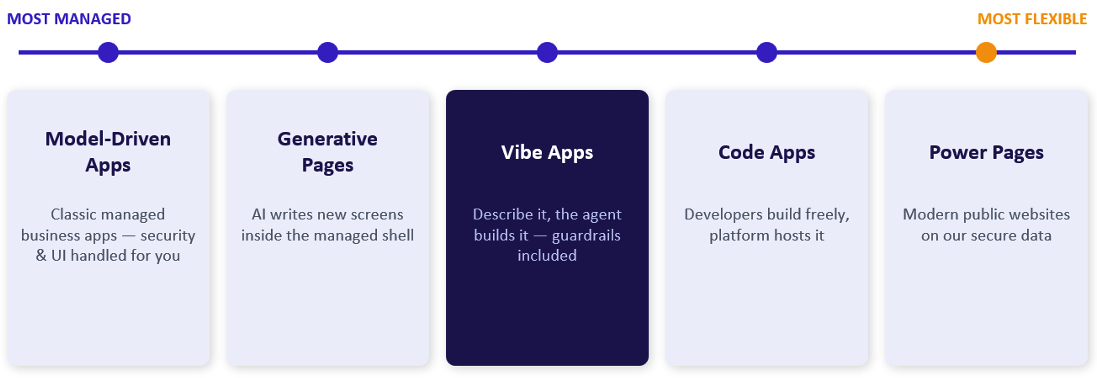
The Power Pages part is worth calling out on its own. The old low-code website builder experiment is over; Microsoft has turned Power Pages into a proper web platform, with React single-page apps, TypeScript server logic, row-level security, built-in web roles, hosting, and enterprise login, including itsme for Belgium. For us, the important point is simple: that this is no longer a choice between low-code and developers. It is one platform where the same data, security and governance sit under every route.
Agents grow up: think, act, check, adjust
If there was one headline from the conference, this was it: Copilot Studio is becoming what Microsoft calls an agent harness. The old generation of agents answered a question by taking its best single shot. The new generation works differently: it thinks, takes an action, checks its own result, and adjusts the plan before it answers.
A detail worth flagging: when you choose the model behind the new orchestrator, the only two options are Claude and GPT, so the reasoning can run on Claude, Anthropic’s model.
The old building blocks are gone. “Topics”, those rigid conversation scripts with their variable inputs and outputs, are being retired, and two things replace them:
- Skills: the recipe book. Written know-how the agent picks up when thesituation calls for it and decides how to apply.
- Workflows: the assembly line. Fixed steps that run the same way every time,for the parts of a process that have to be predictable, like approvals.
The craft going forward is choosing, step by step, whether something needs judgment, an agent with a skill, or repetition, a workflow. The conference confirmed a rule of thumb we already apply with our clients: use plain automation wherever the steps are known, because it is cheaper and faster, and spend AI only where reasoning earns its keep.
Agents can call short-lived sub-agents for a single task, workflows can call agents and vice versa, and you can test a workflow node by node. Large documents are no longer a problem, tools can run in parallel, and agents finally have built-in memory, something that simply was not there before.
Testing got serious too. Evaluations are now a real part of the loop: you build a test dataset, import real cases from production to try out a specific scenario, and check that the agent behaves before you ship it. Azure AI Foundry models can be brought in through three routes: the AI Builder tool, a flow calling a Foundry model, or a connected agent referenced by its agent ID. Foundry plugs in as a model, though, not as the orchestrator itself.
One more thing on UI. Rendering a visualisation on the fly burns far more tokens than letting a model-driven app draw it, where the record lookups are already built in, so the model-driven route is both better governed and cheaper to run. Something that was not covered in the official sessions: will canvas apps become another way of exposing an app through Copilot? And if so, will Adaptive Cards still be needed at all? I, at least, will be very careful when using Adaptive Cards from now on.
Keeping it safe: Agent 365
If agents are going to behave like coworkers,they need what every employee has: an ID badge, a manager, and rules. That is Agent 365, a control plane for agents.
It works in three movements:
- Discover: it finds every agent in the company, including the shadow AI someone quietly installed on their own laptop. Teams apps count too, since they run on the bot framework. In the demo, the example shadow tool was nicknamed “OpenClaw”; Defender and Intune are what spot these.
- Analyze: it sees what data and tools each agent touches, detects sensitive information with a prompt, applies labelling, and tracks what each agent costs in tokens, including, external agents. A registry sync pulls in outside agents and their resources.
- Act: policies kick in: set DLP rules, block risky agents, block whole categories of external agents, and allow the useful ones.
The elegant part is that every agent already gets an Entra identity automatically, a company ID badge, so there is no migration project to run. In practice, governance is always a cooperation between Defender, Agent 365 and Purview, with Intune added for mobile devices.
An honest caveat from the session: a locally installed Windows app, if it got through, like OpenClaw can be detected but not fully governed, and the same gap shows up when a tracked agent combines otherwise-valid datasets to produce something it should not. So this lowers risk; it does not take it to zero.
What this means for us
So what do we actually do with all this? None of it is future talk anymore; the tools are here and already in production.
Three concrete moves, in order:
1. Bring one app to Copilot. Pick a single app and connect it.Timesheets-from-calendar is a small, visible win.
2. Pilot the new agents. Rebuild one process in the new Copilot Studio: skills for the judgment calls, workflows for the fixed steps.
3. Get governance ready first. Switch on Agent 365 visibility before agents multiply. Trust is the foundation, not an afterthought, which is exactly where the keynote started.
It fits neatly with how we think at MbarQ: find the business need first, then build something tangible, feasible and scalable on top of it. The tooling just got a lot better at all three. The pendulum will keep swinging between working in apps and having apps come to us, and our job is to be good on both sides of it.
My road into agentic development
The most useful thing I took home was not on any slide; it came from the hallways. A lot of speakers and consultants I spoke to are already building production apps with agentic coding tools. Not experimenting on the side; shipping. That is the part I keep coming back to, and it is why the rest of this is a personal note about the road I am on right now.
One session outside the Power Platform track pushed me the furthest: a pro-code talk on Azure Functions, the Web API and the “tokenomics” of building in the agentic era. It was less about features and more about how to work with these tools well. A few of its lessons have stuck with me.
The one that stuck hardest is not to lean on “skills” for everything: wrap the predictable parts in deterministic tools instead, the way their C# build extension automatically tidies code and flags the ugly bits. When build errors appear, the AI can rewrite the code based on the error output. It also pays to let one main agent do the planning and hand specific jobs to focused sub-agents, one for the model-driven app, one for deployment, and so on. And a newer model is not automatically the better one, so get everything around it right first; an older model with a couple of extra retries will often come out ahead.
It matches where Microsoft is clearly heading.They are investing heavily in VS Code extensions across the whole Power Platform, including building Copilot Studio agents straight from the terminal via the Copilot Studio MCP plugin. Agentic engineering is not a side track to Power Platform work anymore; it is becoming the way the platform gets built.
A marker of how far this has come, at least for me: I have not written code by hand in a few months now. I describe what I want, let the agent build it, and step in to validate only where it matters. What surprised me at the conference was how many other speakers and colleagues working this way said exactly the same thing.
That is the road I am on: skills for the judgment calls, deterministic tools for the repetitive parts, sub-agents for focused jobs, and MCP to connect it all to real systems. I am documenting the journey as I go: the setups that work, the ones that waste a weekend, and what it takes to bring agentic development into day-to-day Power Platform delivery. If you are building this way too, follow along and let’s compare notes.
Power Platform Solutions Architect
This is the era of AI. In the past, AI was for scientists and technicians. Nowadays, it’s essential for everyone. Including your business.

Part of


© 2025 MbarQ all rights reserved