
Meet Silke Brusselmans: the AI Translator making innovation work for people
AI may be evolving rapidly, but meaningful transformation still happens on a human level. Meet Silke Brusselmans and discover how she helps organizations bridge the gap between AI innovation and human adoption as an AI Translator at MbarQ.
5 MIN
July 14, 2026
.png)
Beyond the technology
The conversation around AI often focuses on technology. New models, new capabilities, new possibilities. Every week seems to bring another breakthrough, another headline, another prediction about how work will change in the years ahead. Yet for Silke Brusselmans, those conversations only become truly interesting when they move beyond the technology itself and start focusing on the people who will ultimately use it.
As an AI Translator at MbarQ, she helps organizations bridge the gap between AI potential and real-world adoption. Her role sits at the intersection of business, technology, and human behaviour, combining business analysis, functional design, facilitation, communication, and change management. But at its core, it is not about systems or models. It is about people.
Because no matter how advanced an AI solution may be, its success is ultimately determined by whether people understand it, trust it, and integrate it into their daily work.
A career driven by curiosity
Silke’s path into AI was never a carefully planned career strategy. Instead, it emerged from curiosity that has shaped almost every step of her professional journey.
“I’ve always had too many interests,” she says with a laugh.
“I’ve always had too many interests,”
That curiosity first led her toward psychology, where she developed a deeper interest in human behaviour and organizational dynamics. It then broughther into project-based environments, where she could constantly explore new contexts, new people, and new challenges. Technology was not the initial goal, but it kept appearing along the way because of her fascination with how thingswork and how systems are built.
At one point, she even taught herself front-end development simply to understand how websites functioned. There was no immediate career necessity behind it. It came from curiosity. Looking back, that willingness to step into unfamiliar territory has become a consistent pattern in her career.
From connector to AI Translator
Rather than moving into highly specialized roles, Silke naturally gravitated toward transversal work: projects that connect departments, disciplines, and stakeholders. She found energy in bringing structure to complexity, aligning different perspectives, and helping groups move in the same direction.
Without realizing it, she was already developing the exact capabilities that would later define her role as an AI Translator.
Today, her work at MbarQ sits precisely at the intersection of business needs, technological possibilities, and human adoption. When organizations explore AI initiatives, these three worlds often speak different languages. Business stakeholders focus on outcomes. Technical teams focus on feasibility. End users focus on usability, impact, and concerns. Silke’s role is to ensure those perspectives remain aligned throughout the entire journey.
Turning needs into meaningful solutions
Her work typically begins with understanding what an organization is trying to achieve. What challenge are they facing? What problem are they trying to solve? Which processes are not working as efficiently as they could? And what would success actually look like?
In that conversation, AI-first thinking becomes part of the way she looks at the problem: not as a push to use AI wherever possible, but as a way to question whether a process can be approached differently from the start. That perspective helps her move from broad ambitions to clear requirements, defining what a solution should do, how it should support users, and what it needs to deliver in practice.
Through workshops, business and functional analysis, and close collaboration with clients and technical teams, she creates the alignment needed to turn an idea into something concrete. The result is not just a solution that works technically, but one that fits the organization,supports the people who will use it, and creates value in a real working environment.
Adoption is where value is created
Yet for Silke, the work rarely ends once a solution has been designed.
In many organizations, implementation is treated as the finish line. In reality, it is only the beginning. A solution only delivers value when people actually use it, understand it, and feel confident working with it.
That is why her role often extends into change management, communication, training, and adoption support. She helps organizations prepare their teams for change, supports communication planning, identifies resistance early, and guides users as they adapt to new ways of working.
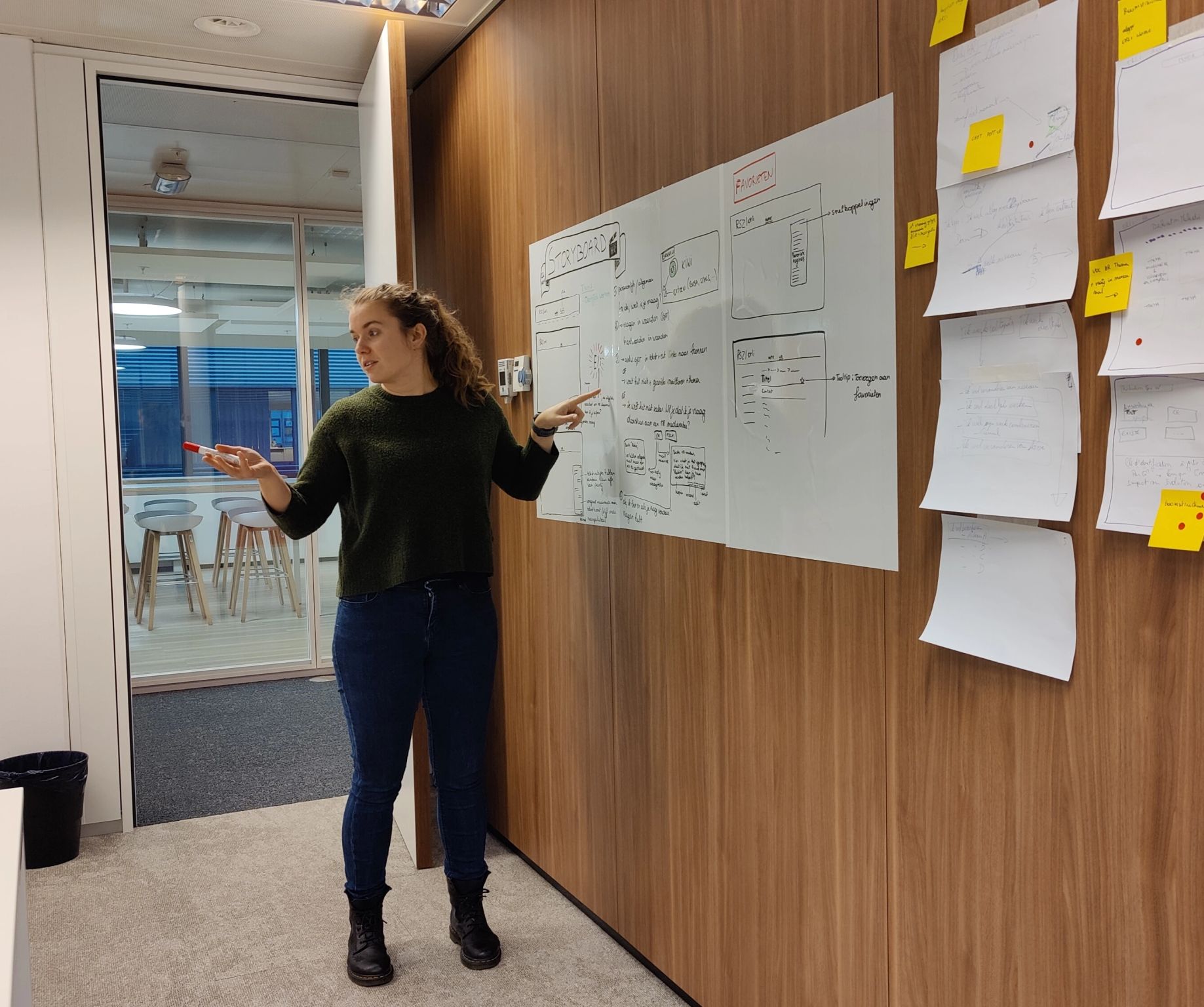
The most rewarding moments often happen in that phase, when perception starts to shift.
“There is something incredibly rewarding about seeing someone go from uncertainty or resistance to thinking: now I understand it, now I see how this can help me.”
Working in a fast-moving environment
Consulting fits her mindset naturally. Some weeks involve multiple parallel projects, each with different stakeholders and objectives. Other assignments are long-term engagements where she becomes deeply embedded in a client’s transformation journey. No two projects are the same, and that constant variation is part of what keeps her energized.
At the same time, working in AI means operating in a field that evolves at extraordinary speed. New tools emerge constantly, assumptions change quickly, and yesterday’s certainty can easily become today’s question mark.
Rather than seeing this as instability, Silke experiences it as part of the appeal. It keeps her learning, adapting, and refining her thinking continuously.
Creating clarity in complexity
One of the most important aspects of her role is helping organizations navigate complexity. The AI landscape is full of hype, competing narratives, and rapidly evolving expectations. For many organizations, the challenge is not a lack of information, but too much of it.
What they need is clarity.
Silke’s work is therefore focused on separating noise from signal and translating technological possibilities into meaningful business decisions.This requires analytical thinking, but also empathy: understanding what people need, what they fear, and what they hope to achieve.
It also requires listening carefully, asking the right questions, and sometimes recognizing what is not being said.
Why MbarQ
When asked why she chose MbarQ, Silke does not immediately talk about AI, projects, or technology. She talks about culture. “It was a vibe,” she says, laughing.
“It was a vibe”
But behind that simplicity lies a clear and consistent explanation. She thrives in environments where people collaborate openly, share knowledge, and support one another in doing their best work. Before she officially started, she was already invited to a company gathering, which gave her an early glimpse into the culture she would later experience every day.
That impression has not changed. She describes a workplace where colleagues genuinely help each other, where knowledge is shared rather than protected, and where autonomy and initiative are encouraged. For her, that combination of trust, freedom, and collaboration is essential.
Always focused on people
Despite working in one of the fastest-evolving sectors in the world, Silke’s motivation has remained remarkably stable. It is not technology for its own sake that drives her, but the impact it can create for people.
Whether she is facilitating workshops, shaping AI solutions, or guiding organizations through change, the underlying goal is always the same: helping people move forward with confidence.
Technology may evolve quickly, but meaningful transformation still happens on a human level, one person, one team, one organization at a time.
For Silke, being an AI Translator at MbarQ is ultimately about ensuring that those transformations succeed. Not by putting technology at the center of the story, but by making sure people never lose their place in it.
Interns at MbarQ: Learning, Innovating, and Growing Together
At MbarQ, we believe internships should be more than just a line on a resume, they should be a launchpad for real growth, learning, and meaningful contribution. Every year, we’re proud to welcome talented interns who bring fresh perspectives, curiosity, and energy to our team. In return, we strive to create an environment where they can explore, challenge themselves, and be part of something that matters.
Read more
The AI Translator: The Key to Successful AI Adoption
As Artificial Intelligence (AI) becomes increasingly important within organizations, the need to align technology and business more effectively is also growing. Many organizations want to implement AI but struggle to translate advanced technology into concrete and feasible business strategies. This is where the AI Translator comes in – a crucial link in successful AI adoption.
Read more
This is the era of AI. In the past, AI was for scientists and technicians. Nowadays, it’s essential for everyone. Including your business.

Part of


© 2025 MbarQ all rights reserved